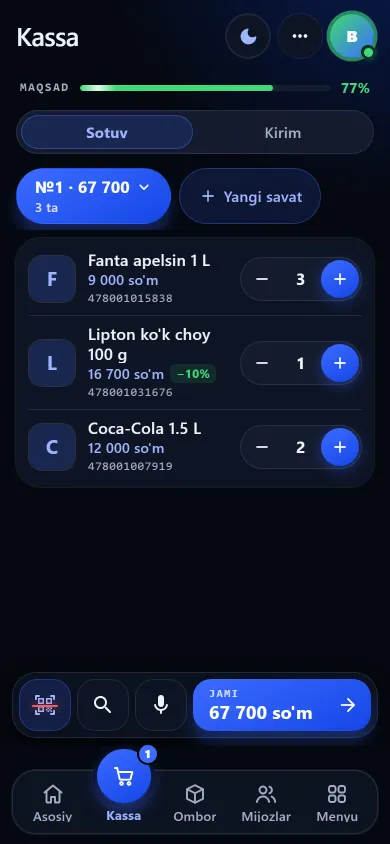
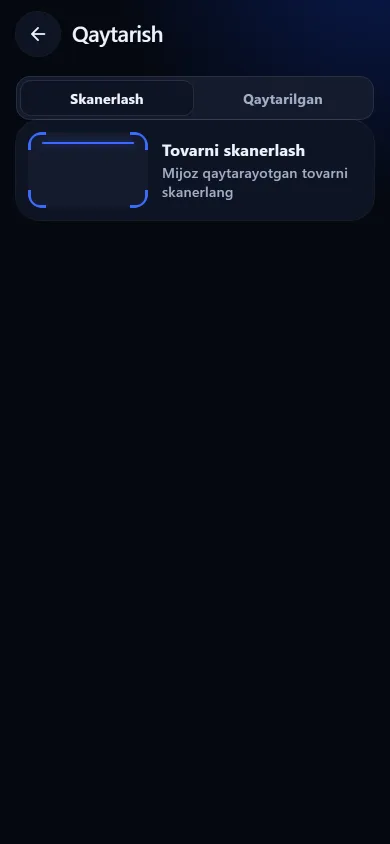
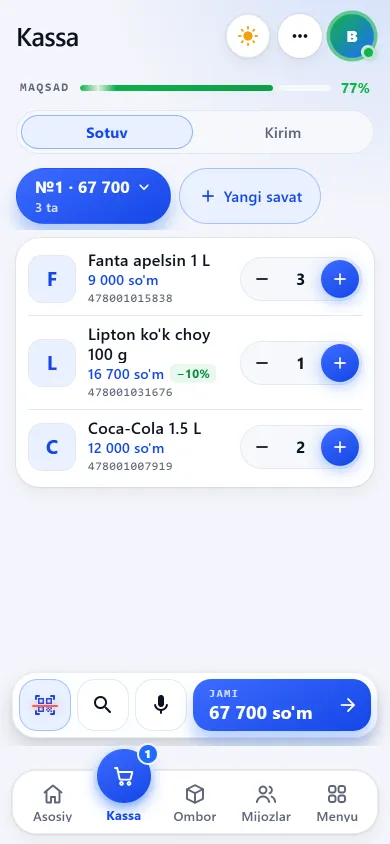
The barcode scanner lives in the seller’s phone: carts, payment by cash, card or credit, 58 and 80 mm receipts and a cash count at day’s end. No need to buy a separate barcode scanner.
This is not a picture. Tap the sections at the top and the icons at the bottom to move around inside the app itself.
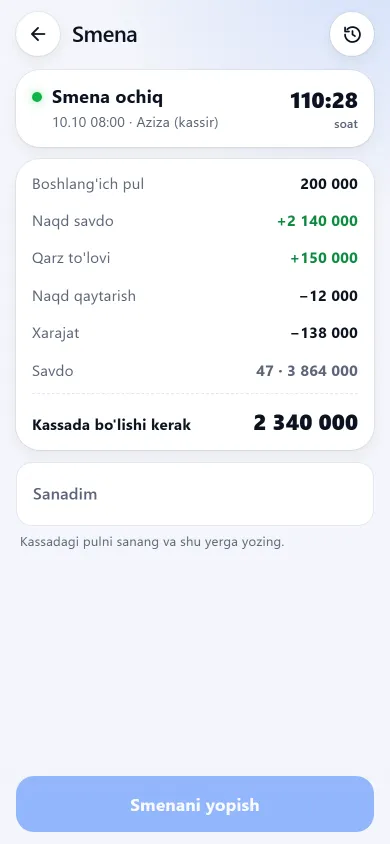
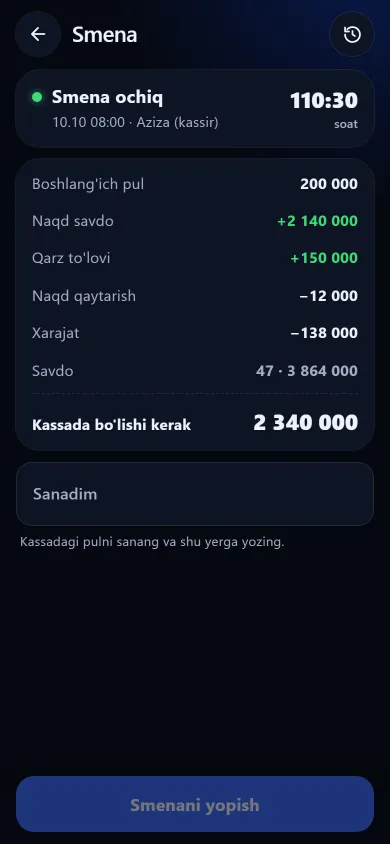
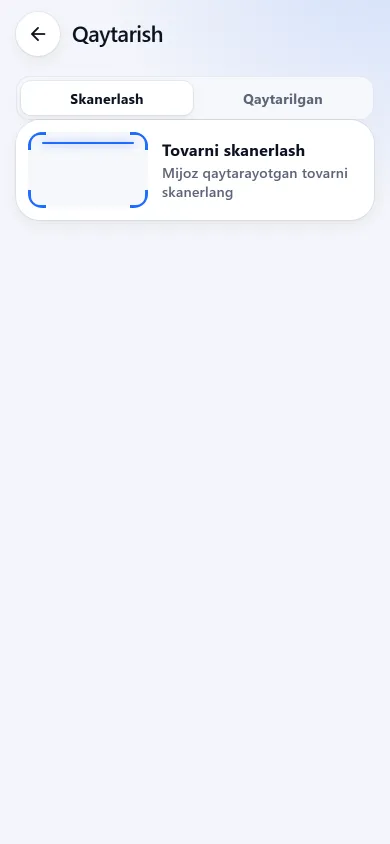
Sales, the scanner, shifts and returns look exactly like this on a phone.

New design
Previous design
New design
Previous design
New design
Previous design
New design
Previous designThese screenshots come from a demo shop: the products, customers and amounts in them are invented. A real shop’s screen shows customer names and their debts, so we do not publish those. The screens themselves look exactly like this.
Tap the scanner button and the camera opens, then stays open through the sale: hold up item after item and anything in your catalogue with stock drops into the cart by itself, while the bottom bar shows the cart name, how many different items it holds and the total. How it reads on different phones is on the phone scanner page.
The worst moment is finding out after you pay that your own codes are not read. So here are the limits up front.
ITF-14, Code-93, Codabar, Data Matrix and PDF417 are not read — the pharmacy marking code is on that list too. Such items get an in-store code and a printed label.
Android and Chrome use the browser’s own detection engine — the fastest path. iPhone and Safari have none, so a library reads the code there.
A label with the weight inside the code is read only in a grocery-type shop. You give the item a scale number (PLU) and enter it into the scale, which must print a 13-digit code starting with 22 for weight or 21 for price.
A USB scanner such as a Honeywell connects as a keyboard: if it sends Enter or Tab after the code, the app tells it apart from typing — in sales, intake and returns. With the cursor in another field, the code’s first two characters can stay there.
When the queue moves you open a second cart, type the quantity by hand and record the money exactly as it was handed over.
Credit selling is its own permission: without it an employee takes only cash and card. If the customer is blocked or over their limit, the sale is not recorded.
A known customer’s name and outstanding debt appear at once; a new one is asked for a name only then. Without a number there is no credit sale.
In a split payment only the remainder becomes debt. A debt made at the till has no due date — write a dated one from the “Add debt” screen or the customer card.
After a sale the app asks whether to print. The receipt carries the shop name, date, seller, items, total and payment type; a phone shop adds the IMEI and warranty period. Printer setup is in the receipt printer guide.
In Profile > Receipt printer you mark 58 or 80 mm. The setting belongs to the shop, not the device: a cashier’s phone takes that size the next time the app opens.
The test receipt and label print through the real path, so what you see on paper is what a sale will produce.
Receipts and labels go out through the browser’s print dialog: pick the printer there and set 100% scale. There is no direct ESC/POS, Bluetooth or driver link.
At day’s end the software answers “how much should be in the drawer”, while you decide how far a seller’s hands reach. More on the staff oversight page.
BuySale does not take the money itself — it records how the money came in. The till has three payment types: cash, card and credit; there is no separate type for QR, terminal or transfer payments.
A card, QR or transfer payment goes through your terminal or banking app — BuySale is not connected to them and does not send them the amount. Check on the terminal or in the banking app that the payment went through.
You finish the sale with the “Card” payment type; there is no separate “QR” or “Transfer” type. If the customer paid part in cash, record a split payment: cash + card.
The report shows cash, card and credit in separate columns, and the evening Telegram summary, when Telegram is connected, lists them separately too. Compare the “Card” total with what reached your terminal or banking app.
A receipt printer with a 58 or 80 mm roll; you set the width once in Profile. The receipt goes out through the browser’s print dialog, where you pick the printer and set 100% scale — there is no ESC/POS, Bluetooth or driver link.
No. It has no fiscal mark, tax QR code or register number — it is the shop’s own sales slip. For a fiscal receipt your registered cash register still works separately — see do I need a cash register.
No. BuySale opens in the browser (app.buysale.uz); on Android you install an APK, and on a computer you install it as an app from the browser — see how to install. You need neither an installer nor a touchscreen terminal. If you need fiscal receipts, the fiscal till stands alongside — see do I need a cash register.
No. BuySale is not connected to bank terminals, UZCARD/HUMO processing or QR payment systems: it does not send the amount to the terminal and does not know when money arrives. The terminal or QR app takes the payment, and in BuySale you finish the sale with the “Card” payment type — the report keeps it separate from cash.
Choose the “Card” payment type: the till offers cash, card and credit, with no separate “QR” or “Transfer” type. First check in the terminal or banking app that the money has arrived, then finish the sale. If the customer paid part in cash, record a split payment of cash + card — as long as no discounted item is in the basket.
In the Android and Windows app, yes, for up to 7 days: sales are queued, stock goes down at once, and everything is sent to the server once the connection is back. In the web version in the browser the till needs internet.
Selling, credit selling, refunds and haggling at the till are four separate permissions granted per employee. Haggling (typing an agreed lower total) is in no ready-made set except “Manager”, and a discount on the product card depends on the price-change permission. Revoke a permission and the employee stops at their next tap — see staff permissions.
The app works out the expected cash and shows the difference against the counted amount at once; when there is one, a field opens for the reason. Closed shifts keep who closed them, how many sales and the difference.
BuySale reads EAN-13, EAN-8, UPC, Code-128, Code-39 and QR with your phone camera: zoom, torch, continuous scanning and manual code entry as well.
Learn more →How to set the receipt printer to 58 or 80 mm, pick a label size such as 40×30, run a test print and fix the usual printing problems in BuySale.
Learn more →A customer returns an item: scan it and the sale is found. Refund in cash, to a card or off their debt; the item goes back to stock and profit corrects itself.
Learn more →Seller control in a shop: shift open and close, the cash difference, sales per employee, permissions that hide cost price — and what it does not do.
Learn more →Do you need a cash register? How online and virtual tills, card terminals and shop software differ, what the rules say, what to ask and where BuySale fits.
Learn more →
7 days free, no payment card needed. Then from 6 630 UZS a day, depending on the shop type.
Start for freeBuySale assistant
Answers from what is published on this site
AI can make mistakes — check anything important via Telegram.
Writing an answer