Opening a second shop no longer means a second sign-up: a branch is opened inside the app, from the main shop’s cabinet. Each branch runs like its own shop with its own goods, till and staff, the money comes off one balance, and you move between shops in one tap.

New design
Previous design
New design
Previous designThese screenshots come from a demo shop: the products, staff and amounts in them are invented. The screens themselves look exactly like this.
Only the shop owner opens a branch, from their own cabinet. It takes a few minutes.
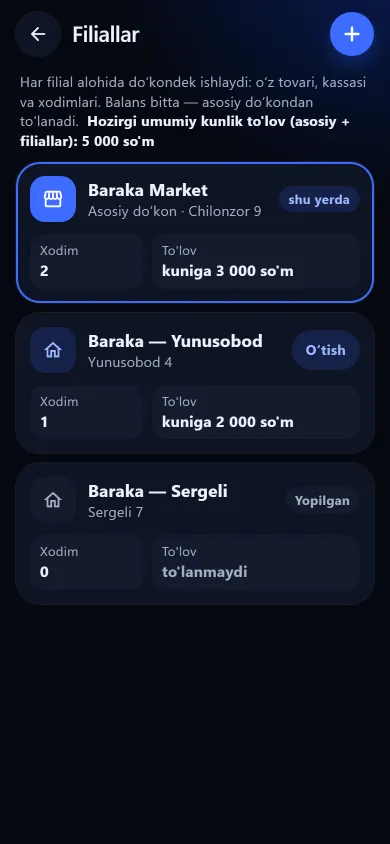
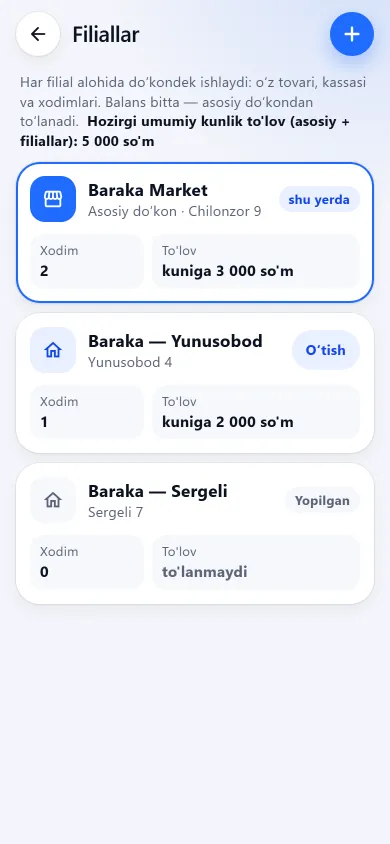
The list shows the main shop and the branches with each one’s address, staff count and daily price. The section is in the menu too.
Type a name (for example “Chilonzor branch”) and, if you like, an address. The app shows the branch’s daily fee right there, before you confirm.
The branch starts with the main shop’s settings: shop type, language, receipt and label sizes. Its stock is empty — transfer goods from the main shop or enter them as goods-in.
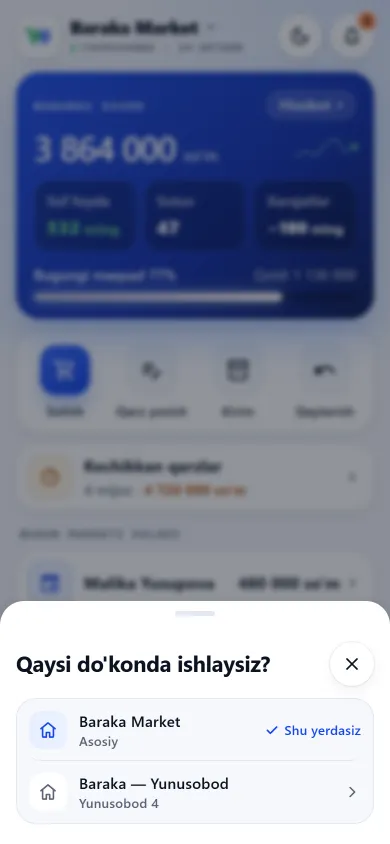
Switch into the branch, add its staff and start trading. While you are in a branch, a “Branch: …” line sits at the top of the screen, so you always know where you are.
Each open branch adds 6 630 UZS a day (198 900 UZS per 30 days). The money comes off the main shop’s balance, starting the day after the branch is opened; trial and gift days are not charged. A closed branch costs nothing from the next day. If you reopen a closed branch, that day’s branch fee may be taken at once — the app tells you before you reopen.
Sees every branch and switches between them in one tap: from the profile header, the left-hand menu on a computer, or “Switch” on the “Branch: …” line. No new code is asked for. If baskets are open, the app asks first — they will be cleared.
Works only in their own branch and cannot switch to another. Under “Sign in as staff” they enter the main shop’s number and their own PIN. PINs are unique across all branches; someone who works in two branches gets a separate staff entry and PIN in each.
Messages go to the main shop’s owner: the evening report (main shop, each branch and the total), staff sign-ins with the branch name, and low-balance warnings based on the combined daily price. Voice debt entry and AI questions in the bot work with the main shop.
Every evening Telegram report starts with the main shop, then each branch on its own, and ends with the combined total (“Jami: asosiy + N filial” — the report is in Uzbek). It is sent according to the main shop’s setting — when switched on, at the chosen hour.
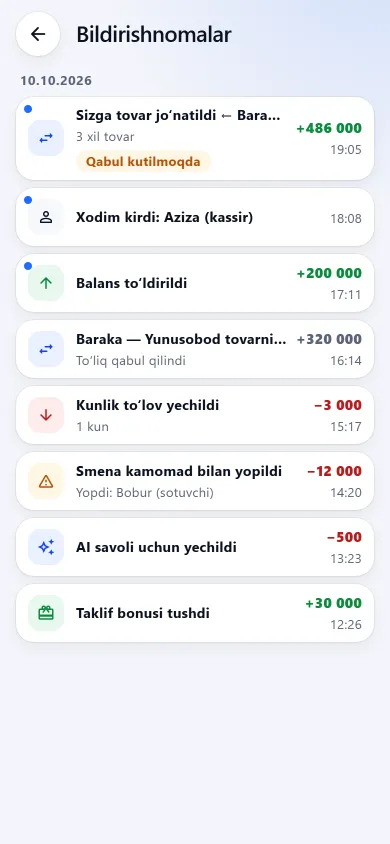
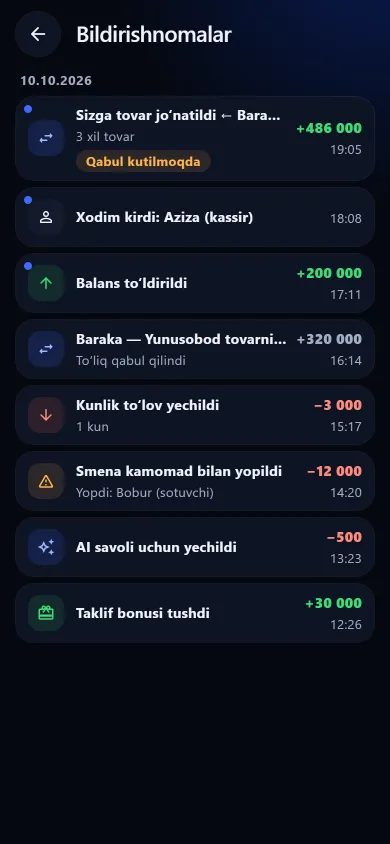
There is a bell at the top of the app (and in the left-hand menu on a computer): it shows the unread count, and a tap opens a list grouped by day — amounts marked “+” or “−”, with the branch and the time. It works in a shop without branches too.

New design
Previous designThese screenshots come from a demo shop: the products, staff and amounts in them are invented. The screens themselves look exactly like this.
We say it plainly up front, so there is no “but I thought it did that” later.
No. A branch is opened from the main shop’s cabinet, with no separate phone number or Telegram account. A shop that was registered separately before cannot be attached as a branch, though — it stays on its own account.
Each open branch adds 6 630 UZS a day (198 900 UZS per 30 days). The money comes off the main shop’s balance, starting the day after the branch is opened; trial and gift days are not charged. A closed branch costs nothing from the next day. If you reopen a closed branch, that day’s branch fee may be taken at once — the app tells you before you reopen.
They tap “Sign in as staff”, enter the main shop’s number and their own PIN, and the app opens their branch. That is why PINs are unique across all branches. If two employees ended up with the same PIN earlier, the owner changes one of them.
In the evening Telegram report: it shows the main shop, each branch and the total (sales, profit, expenses, credit) for the day. The in-app Reports are separate for each branch — there is no in-app report that adds all branches up by week or month.
Yes. Each branch has its own product cards and selling prices. Goods that arrive by transfer as a new card take the sending shop’s selling price; added to an existing card, they leave its price unchanged.
Yes. A branch starts with the main shop’s type, and you can change it inside the branch under Profile → Shop — a pharmacy branch of a grocery, say. Fields such as expiry dates, sizes or IMEI follow the branch’s own type.
Everything stops together — the main shop and the branches. Stopped days are not charged and no data is deleted. Once the balance is topped up from the main shop’s cabinet, everything runs again. The negative balance rule applies to branches too.
Each seller’s net sales, receipts, returns and shift shortages, with a monthly target and bonus worked out for you. Sales history shows who sold what.
Learn more →Daily profit tracking: revenue, net profit, expenses and who sold what — today, last 7 or 30 days. Nightly Telegram summary if connected. 7 days free.
Learn more →Shop accounting via Telegram: the bot sends you sign-in codes, the nightly profit report and staff sign-in alerts; customers see their debt. Not a web shop.
Learn more →Inventory software on your phone: stock and intake, fields filled from a label photo, batches and expiry, low-stock alerts, stocktaking and Excel.
Learn more →
7 days free, no payment card needed. Then from 6 630 UZS a day by shop type; branch pricing is on the pricing page.
Start for freeBuySale assistant
Answers from what is published on this site
AI can make mistakes — check anything important via Telegram.
Writing an answer